What makes the tooth a measure of time?
A tooth cuts, bites, and chews. It crushes, grinds, and mixes. Straight-edged, pointed, or broad and flat, teeth come together to form a set that, within the resonant chamber of the mouth, becomes an instrument of speech and, outwardly, shapes the appearance of our facial features.
The tooth of time, however, is a measuring device. It takes stock of the present, its progress and its decay, piece by piece, digesting the consumed state of reality. The eight artists in the exhibition (Zieh mir den) Zahn der Zeit form the dentition of this inquiry into the present. Through their practices, they examine the loose teeth, the ones that ought to be pulled, and the tooth gems that glint from within a sly, quiet smile.
Without following a unifying curatorial framework or a predetermined thematic or medial orientation, the exhibition opens a space for such an inquiry into the present. The assembled positions encounter one another openly and without preconception. What emerges is not a closed narrative, but rather a web of individual perspectives that raises questions of transformation, of positioning in time and space, and of the reciprocal influences between inner and outer worlds. The gallery space becomes a mirror of the daily condensation of images, information, stimuli, and traces that seems to envelop us like a rapidly growing forest. With similar density, the fifty works presented in the exhibition surround visitors, allowing them to cast a glance at the Zahn der Zeit through their thicket of canvases, metal works, textile coverings, and VHS tape.
Seemingly driven by an inner dynamics, the bodies in Elias Binder’s works twist around themselves, around other bodies, and across the surface of the canvas. In the spirit of the Old Masters, Binder uses the human body as a tool of compositional inquiry, directing attention not only to the appearance and painterly physicality of humans, animals, and draped materials, but also to his precise engagement with color, space, and light. A frame of reference shaped by his studies in architecture is unmistakable in the spatial expression of his conceptually structured works, yet his organic visual language remains rounded and gentle. Elias Binder completed both his bachelor’s and master’s degrees in Architecture and Urban Design and lives and works in Stuttgart. His work has been presented at Pleks Fellbach in Stuttgart in a solo exhibition as well as in various group exhibitions, including at Kunstbezirk (Stuttgart) and Hugo Boss (Metzingen).
Isabelle Heske’s visual language is both reduced and lively. Geometric bodies and lines drawn using thread or fabric find a place in her works alongside ornamental patterns and organic curves, each element granted equal presence. With a keen sensitivity to painterly technique and a pronounced material awareness of textile surfaces, she gives form to themes of desire, identity, and self-representation. Striving for painterly permanence, Heske’s works question the trend-driven ephemerality and consumerist frenzy of contemporary society and the cultural sector. Her wall pieces, sometimes more and sometimes less strongly inclined toward sculpture, as well as the oversized ‚Wands‘ that rise dramatically upward, reference memory, emotion, fashion, music, and pop-cultural phenomena. Isabelle Heske studied painting at the Kunstakademie Düsseldorf and at the École Nationale Supérieure des Beaux-Arts in Paris. Her work has been exhibited internationally, including at Weserhalle (Berlin), Kunstpalast and NRW Forum Düsseldorf, DOD Galerie (Cologne), MMIII Kunstverein Mönchengladbach, Krefelder Kunstverein, Mixer Arts Gallery (Istanbul), and the Kunstsammlung Nordrhein-Westfalen.
Karim Hussein repeatedly appears in his own works. At times as an unmistakably autobiographical reference to himself, as in the piece 'Mommy and me (dining room, bonnard)’ which shows a scene at a coffee table decorated with flowers and fruit with his mother and him rising up behind it as solid, monolithic figures. At other times he appears less obviously, set against travel landscapes, carrying a walking stick with a small bundle slung over his shoulder, or resting peacefully before a sunlit horizon lined with clover leaves. Not infrequently these alter egos are accompanied by animal-like creatures on Hussein’s canvases. In ’seeking my very own sun’, for instance, a fox- or cat-like quadruped strolls across the foreground from right to left. Behind it stands a human figure, and behind that a landscape scene, each layer closely compressed, spatially almost inseparable, as is typical of Hussein’s practice. Born in Linz, Austria, he engages with his own bicultural background in his works, shaped by an Austrian mother and an Egyptian father. Karim Hussein studied Fine Arts at the University of Art and Industrial Design in Linz and at Kunsthochschule Weißensee in
Berlin. His work has been shown, among other places, at Schlossmuseum Linz, Stadtmuseum Linz, Kunsthalle am Hamburger Platz (Berlin), Galerie Anton Janizewski (Berlin), and Weserhalle (Berlin).
Simay Keles lives and works as an artist in Berlin. Born in Izmir, Turkey, she moved to Germany at the age of eighteen to study painting. Frequent relocations and travels across cultures have always been part of her life, and her practice similarly moves between the two worlds of abstraction and figuration, shifting from one series to the next. In her current body of work, Sunset Express Tours & Travels, she addresses those who have had to leave their birthplace, as well as those drawn toward distant places for many different reasons. By shifting the painted canvas to the reverse side of the stretcher bars and stretching painted transparent fabrics across the front edge, she creates a sculptural spatiality within the works. What may initially appear visually disorienting becomes an exploration of the limits of pictorial space and the relationship between image, image surface, and support, an exploration that seems to unfold new dimensions not only on a second, but also on a third and fourth viewing.
Kay Lotte Pommer paints in, on, and with metal and glass. Delicate figures cut through wall pieces made of steel, metal, and glass, while fleetingly placed traces contrast in their fragile movement with the stability of their supporting materials. Pommer collects such traces in everyday life. She reads the city as a legible network of surfaces, materials, and objects in which actions and time inscribe themselves. The works shown in the exhibition examine, through this urban archive, the production of signs in urban space. Signs as clues, remnants, and visual traces, but also in the metaphysical, imperative sense that instructs, directs, or prohibits actions. Thus, a photographic detail of a defensive architectural fence finds its way into her works. Through graphic reduction it is detached from its functional context and translated into abstract, serially arranged fragments of form that appear as omissions within the metal surfaces, readable almost like characters of a script. Kay Lotte Pommer studied at Burg Giebichenstein University of Art and Design in Halle and at the Academy of Fine Arts Leipzig, where she is currently a Meisterschülerin under Prof. Joachim Blank. She works both as an artist and a curator, and her works have been presented in solo exhibitions at Kunstverein Leipzig and Super Bien! Berlin, as well as in group exhibitions at the Museum der Bildenden Künste Leipzig, Bsmnt Galerie, Culterim (Berlin), Phoenix (Athens), the Department of Art (Chicago), and Galerija Reflektor (Serbia).
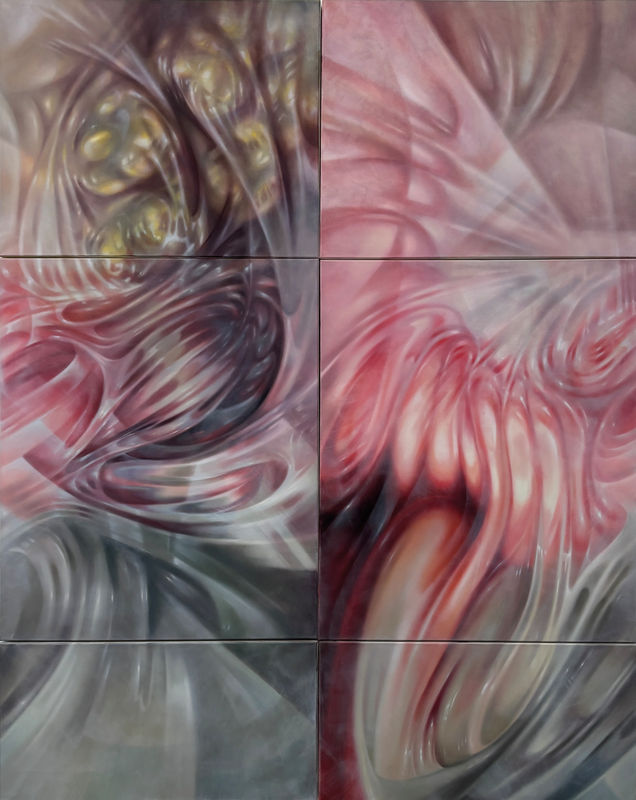
The motifs in Anja Rausch’s paintings resist any clear formal definition. Whether we are looking at close-ups of technical instruments, organic matter, or reflective pathways of light remains uncertain. Yet such definition is not the goal of these works, which embody the painterly process itself rather than the mere depiction of an object or condition. The flowing movements, perhaps more aptly described as dynamic forces of color and light, radiate both calm and rhythm. Positioned between figuration and abstraction, reality and imagination, Rausch’s paintings open up a liminal space in which perceptual precision and conceptual openness coexist. Anja Rausch completed her bachelor’s degree in Communication Design at the Design Faculty of the University of Darmstadt and has been a Meisterschülerin at HFBK Hamburg under Prof. Jorinde Voigt since 2024. Her works have been presented internationally in various group exhibitions and were shown for the first time in a solo exhibition in Berlin in March 2023. In spring 2025, her first institutional solo exhibition took place at the CICA Museum in South Korea.
Pepi Schikowski’s works demonstrate that even difficult and uncomfortable subjects can be approached playfully and with childlike curiosity. Lions, how could it be otherwise, become embodiments of an exploration of toxic masculinity and stereoptypical images of the heteronormative male. Death rides into colorful landscapes wielding an Excalibur-like sword and encounters in the exhibition a butterfly figure that seems to be ‚just drifting‘. The two face one another, and although they may initially appear dichotomous, the butterfly as a symbol of living transformation and death as the end of all life, this strange pairing opens onto a deeper interpretative framework. The butterfly, for instance, might also be read as the soul of death’s victims, freed from the body. A belief that already existed in ancient Greece and still forms part of cultural traditions in countries such as Mexico and Japan. With soft layers of color and blurred contours, Schikowski’s symbol-laden paintings tell stories of mythology, life, and love. They raise questions about power and hierarchies and, even in their engagement with vulnerability and death, never lose their sense of humorous poetry. Pepi Schikowski studied Fine Arts at the Hogeschool voor de Kunsten Utrecht and at the Academy of Fine Arts Leipzig. In 2022 he won the Buning Brongers Prize, after which his works were presented in various group exhibitions in the Netherlands, the United States, Switzerland, Bulgaria, and Germany.
Tim Vormbäumen’s practice encompasses painting, sound, video, and occasionally sculpture. His works take shape in hybrid formats in which visual art, film, and installation overlap. Image, figure, sound, and time function as equal layers that fold into one another. Music provides a continuous structure, as rhythm, as memory, as a bond between the media. Central to this is the singularity as a tipping point: not as a future scenario, but as a present condition, a moment in which orders become unstable and identity, body, and technology begin to merge. Tim Vormbäumen studied at Kunsthochschule Weißensee in Berlin and at the Kungliga Konsthögskolan (Royal Institute of Art) in Stockholm. His work has been shown, among other places, at 2322 (Berlin), during Kunstnacht Demmin (Demmin), in connection with the Eb-Dietzsch Art Prize (Gera), at Galerie erster erster (Berlin), Spoiler (Berlin), and Teatro Avenida (Maputo, Mozambique).